
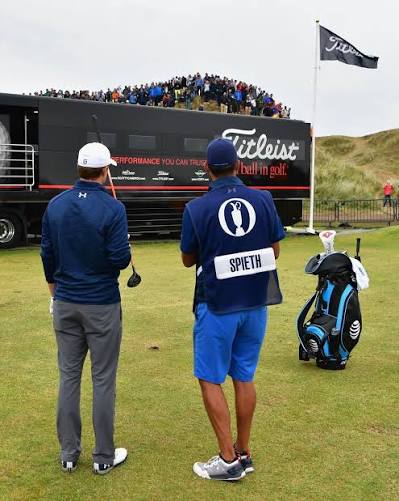
In honor of The Open Championship returning to Royal Birkdale this week, we’re revisiting one of the most unforgettable moments in modern golf: Jordan Spieth’s 29-minute decision on the 13th hole during the final round of the 2017 Open.
Spieth started Sunday with a three-stroke lead, but by the time he stood on the 13th tee, he was tied with Matt Kuchar. Under immense pressure, Spieth hit a wild slice nearly 100 yards right of the fairway, landing deep in the treacherous, marram-grass-covered dunes.
The Anatomy of a 29-Minute Bogey
From there, the clock started ticking. What followed was a highly calculated rules odyssey:
Realizing his ball was sitting at the base of a massive dune, Spieth quickly declared it unplayable.
Understanding Rule 28 (now Rule 19), Spieth and his caddie, Michael Greller, realized they could take back-on-the-line relief as far back as they wanted.
That line took them straight backward onto the Royal Birkdale practice ground. The obstacle? Massive equipment trucks — including the Titleist tour van — blocked his line of sight.
For over 20 minutes, Spieth, Greller, and R&A officials meticulously walked the range, determined the line of maximum relief, navigated the temporary immovable obstructions (the trucks), and figured out a yardage.
Spieth striped a blind 3-iron over the dunes, pitched on, and made a 10-foot putt to escape with a "ho-hum" 5.
The Greatest Closing Run in Open History
It is easy to let down after that, but Spieth kept the momentum going:
14th: Birdie (nearly a hole-in-one)
15th: 48-foot eagle (the "Go get that!" classic to his caddie)
16th: Birdie
17th: Birdie
He played the final five holes in 5-under par to lift the Claret Jug.
Strategic Deliberation vs. Slow Play
At Pace Patrol, we are not fans of slow play, but there is a massive difference between being unprepared and strategic deliberation in a major championship. Spieth used every second allowed by the rulebook to turn a potential disaster into a historic, momentum-saving bogey.